
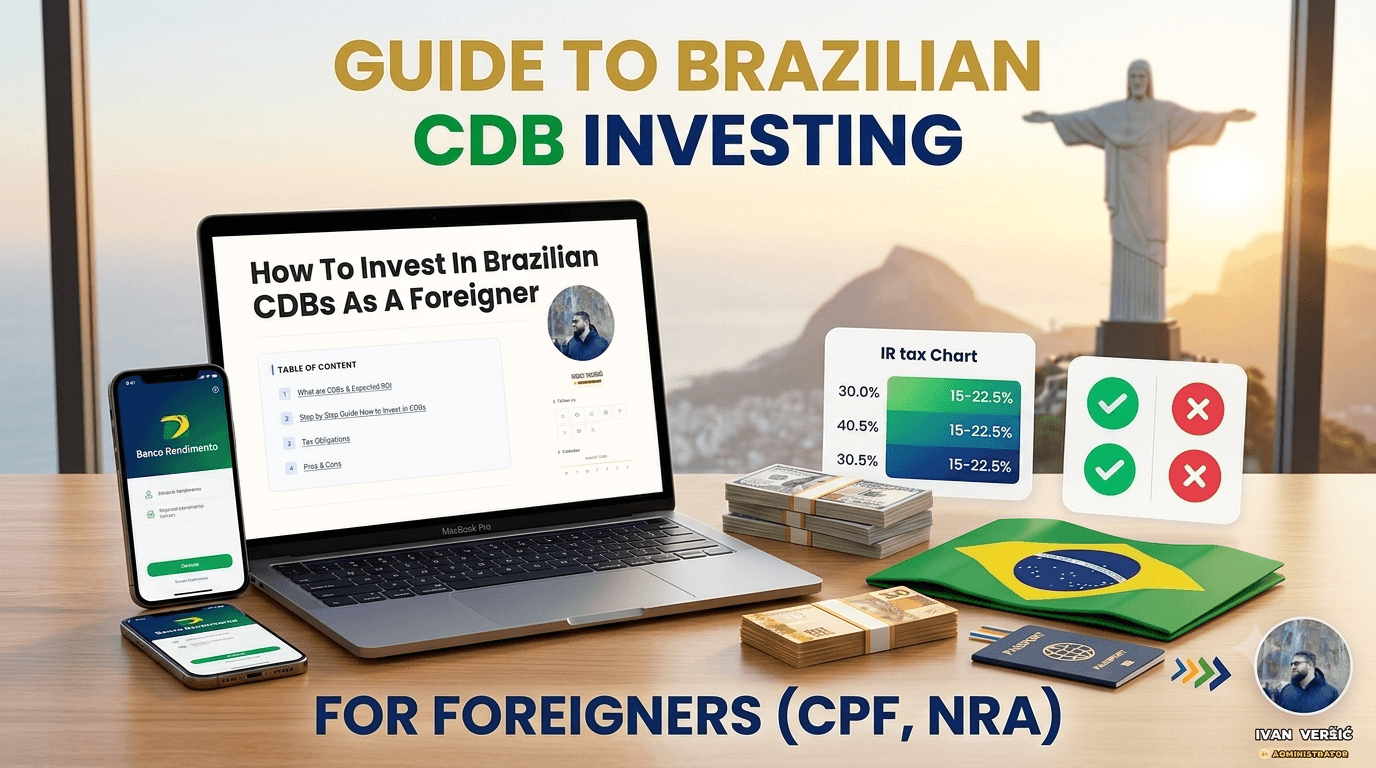
Table of Contents
Requirements for this guide and links that show how to acquire them:
Valid CPF number
Banco Rendimento non-resident account (NRA)
1. What are CDBs & Expected ROI
CDBs are bank deposit certificates, basically you will be lending your money to Brazilian banks and they will pay you back a percentage that you’ve negotiated.
First we will get into types of CDBs that are offered in Banco Rendimento, we have two options directly available in the app: Pre-fixed CDBs and Pos-fixed CDBs.
Pre-fixed CDBs = interest rate (%) stays the same throughout the period of investment after it is locked in, the bank does not adjust your rate based on CDI fluctuations during the investment period. They will offer you an interest rate that they think will be the closest to the CDI in the next x years that you want to invest. This could be good or bad for you, if you lock in let’s say a 12% rate for 5 years and first 2 years CDI goes to 15%, you are losing 3% per year. If the CDI drops to 9% over the next 3 years, you earn 3% above the market rate because your 12% fixed rate is locked in.
Pos-fixed CDBs = interest rate (%) fluctuates according to the CDI rate which changes daily with larger changes happening once a month or two. Different from pre-fixed CDBs, your rate will change on each payout during the period of investment.
Both types of CDB investments have different application terms and you have daily liquidity and no liquidity options. Application term = period where your money will be invested, liquidity = daily means you can take your money out any time while no liquidity means your money is locked until the application term ends, usually second one gives better interest rates at the cost of you not being able to cash in whenever you want.
2. Step by Step Guide How to Invest in CDBs
Alright, it’s pretty straightforward – You will go into your Banco Rendimento account, tap on “Invest”, there you will see three brackets, first one you will select the type of investment from the options we discussed above, second you will choose the application term and third you will put the value of how much you want to invest and confirm. Minimum amount to invest is 1000 BRL (196.72 USD – today).
3. Tax Obligations
Taxes are the reason that most investors are afraid to invest in other countries as the consequences of failing to report and pay them could be as painful as in our own countries.
This is why I’ll help you out here because it wasn’t that easy for me the first time. First we have something called IOF (Imposto sobre Operações Financeiras), a sneaky little tax that will eat (almost) all of your capital gains if you choose to sell your CDBs within the first 30 days. For long-term investors (30+ days) this is no issue as this tax will not be applied anymore once those 30 days pass.
Now we will focus on something much more crucial, the income tax – IR (Imposto de Renda), which includes capital gains tax. This is a regressive type of tax which means that it will start higher and go lower as the application term passes, here is how it works:
Brazilian IR (Capital Gains Tax)
Tax rates applied based on investment holding duration
Up to 180 days
22.5%
Tax Rate
181 to 360 days
20%
Tax Rate
361 to 720 days
17.5%
Tax Rate
Over 720 days
(2+ years)
(2+ years)
15%
Lowest Rate
Now let’s talk about double-tax treaty, if your country has DTT with Brazil, the treaty will cap the IR and make you pay the difference to your home country. If your country doesn’t have DTT with Brazil, it works like this:
You will need to check the capital gains tax in your country and compare it to the Brazilian IR. The IR will be automatically deducted once you sell your CDBs, but most of the countries use worldwide taxation system so for your country you must report the capital gains tax even if the gain is nothing or tax is smaller than the IR.
As an example if you pulled the money out after 2 years and paid the 15% IR to Brazil, you will report your capital gains tax in your yearly tax report to your home country. Should the percentage of IR be lower than your local capital gains tax, you will need to pay the difference to your home country, should the IR be higher than your local capital gains tax, you still need to report it but you won’t pay any additional tax as you’ve already paid it to Brazil (IR).
4. Pros & Cons
Here let’s talk about pros & cons of investing in Brazilian CDBs and for who this is a good option.
Good for
- Long-term investors Lowest tax brackets (15% for 2+ years), no IOF.
- Safety concerned investors FGC protection up to 250,000 BRL per CPF and banking group (~$49,180 USD today), daily liquidity options.
- Yield lovers Decent annual yield (usually 10–15%) and compound interest.
Bad for
- Short-term traders Brutal IOF and high IR rates.
- Investors that will convert back If you convert back to USD/EUR you could lose on FX conversion (BRL to USD, EUR, etc.). Best to reinvest or spend in BRL.
